The Long Walk from Clubhouse to Touchline
See how a rugby clubhouse carries club life beyond match day, welcoming newcomers and connecting players, volunteers, families, and supporters.
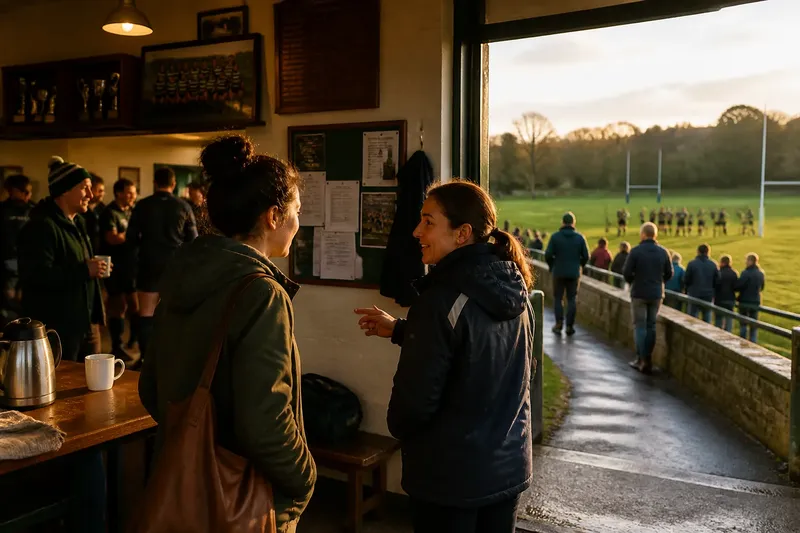
On a damp Saturday, a newcomer pauses at the clubhouse door while boots thud across the hall and a kettle clicks off in the kitchen. The rugby clubhouse can feel like a room with its own customs, but its real work is ordinary: giving people a place to meet before the match, return afterward, and belong between fixtures.
A club beyond the pitch
A clubhouse is not simply a changing room with a bar attached. Depending on the club, it may include a kitchen, meeting room, trophy case, equipment cupboard, or a modest covered area facing the field. Each space supports a different kind of participation. A player may come for training; a parent may help prepare food; a supporter may arrive to watch. Their reasons overlap without needing to be identical.
That shared use matters because a rugby club runs on more than the fifteen players who take the field. Coaches, team managers, grounds staff, volunteers, families, and supporters all contribute in different ways. A common room makes those contributions visible. Someone who helps lay out cones one evening might later be introduced to a match-day volunteer, or learn whom to ask about joining a social team.
The clubhouse also gives the club a place to keep its everyday memory. A noticeboard might carry training updates and volunteer requests; a shelf may hold old team photographs. These objects are not the club’s whole history, but they help newcomers see that the team they are watching is part of a continuing local community.
Before the whistle
Imagine that Cedar Vale Rugby Club, an invented club, has invited Maya to watch its home match. She has never attended a rugby game and knows one current player through a coworker. The invitation says to meet at the clubhouse, but gives no further directions.
Maya arrives while players are changing and notices that some people head straight toward the pitch. Rather than assuming she should follow, she asks the person at the entrance where visitors usually meet. A volunteer points out the serving hatch, the route to the field, and a bench where people wait for friends. That brief exchange does more than provide directions: it lets Maya choose how involved she wants to be.
In a club with a clear welcome, someone may explain who is playing, when the match begins, and where spectators can stand. Those details are useful because they reduce the small uncertainties that can make an unfamiliar room feel closed. A visitor need not be given a full history of the club. A name, a friendly introduction, and a simple orientation are often enough to start.
For a club member, the same pre-match space can be practical rather than social. A team manager checks who has arrived; a volunteer collects bibs; a coach speaks privately with a player. The clubhouse works best when these activities can happen alongside casual conversation without making every visitor feel they have interrupted a private gathering.
From the room to the field
The walk from clubhouse to touchline is a small transition with a useful purpose. Inside, people can talk, find companions, and ask questions. Outside, attention shifts toward the players and the match. A club may have a path, gate, or paved area linking the two; the exact layout varies, but the route helps turn a gathering into a shared occasion.
At Cedar Vale, Maya walks out with the volunteer who first greeted her. The volunteer shows her a place to watch from and introduces her to another supporter. Maya now has someone to ask if she cannot see what is happening, but she is not expected to learn every law or join in every chant. The club has made attendance easier without turning welcome into a performance.
That distinction matters. Some visitors are keen to talk; others prefer to watch quietly. Some players want a focused pre-match routine, while others chat with family. A clubhouse can accommodate these differences with a few simple habits: make the route to the field easy to identify, tell newcomers where they may stand, and let people decline conversation without treating it as rejection.
Small practical details support the same aim. A sign can indicate the pitch entrance, while a notice near the door can show where match information is posted. If a club has separate areas for players and spectators, a clear explanation prevents accidental wandering. Where access, safeguarding, or venue rules shape visitor movement, follow the club’s stated arrangements and ask a responsible club official if anything is unclear.
After the final whistle
When the match ends, the clubhouse becomes a meeting point again. Players may return to change, supporters may look for friends, and volunteers may clear cups or gather equipment. The room reconnects people who watched from different spots around the ground. It can also give the match a natural ending: a chance to thank a host, talk briefly about the day, or arrange another visit.
At Cedar Vale, Maya returns with her new acquaintance and finds that a few players have come in. She offers a simple congratulations, then asks which team plays next week. One player points her toward the club’s public fixture notice, and the volunteer explains that visitors are welcome at the next home match. Maya leaves with a concrete reason to return, not an obligation to join the club on the spot.
This invented situation shows how a clubhouse can extend a match into a relationship with the club. The outcome is modest: a newcomer knows where to go, who to ask, and how to find the next fixture. Those are useful beginnings. They also leave room for the club to explain other ways to take part, from watching regularly to helping with a task or joining a team, if the visitor is interested.
What makes a welcome last?
A warm greeting helps, but a lasting welcome depends on whether the club makes its routines legible. Visitors should be able to tell where to enter, where spectators belong, and whom they can approach. Members should be able to use the same space for necessary club tasks without feeling they must host every person at every moment.
Clubs can make that balance easier by agreeing on a few ordinary practices:
- Keep match-day information in a visible, consistent place.
- Make sure a visitor can identify a person to ask for directions.
- Explain the route between the clubhouse and spectator area in plain language.
- Leave room for people who want to watch quietly as well as those who enjoy conversation.
- Offer a clear next point of contact for anyone who asks about future fixtures or joining in.
These habits need not turn the clubhouse into a formal reception desk. Their value is that they make club life easier to enter while preserving the relaxed familiarity that regular members appreciate. Each club can adapt them to its rooms, grounds, and match-day routines.
Clubhouse questions?
What happens in a rugby clubhouse?
It often serves as a meeting place for players, volunteers, families, and supporters before and after matches. The exact facilities and activities depend on the club.
Can I visit a clubhouse without being a member?
Many clubs welcome visitors for home fixtures, but entry arrangements differ. Check the club’s public information or ask a club contact before you go.
How can a newcomer join in?
Start by asking about the next fixture, a public club event, or a volunteer task. You can take time to watch and get to know the people before deciding whether to become more involved.
Why does the clubhouse matter if the match is outside?
It gives people a shared place to meet, exchange practical information, and reconnect after watching from around the ground. That routine helps the club remain present in local life between matches.
The long walk from clubhouse to touchline is less about distance than welcome: a door opens, a person offers useful direction, and the match becomes easier to approach. For anyone curious about rugby traditions, the clubhouse is a good place to notice how a club makes space for people who have not yet learned all its customs. If you visit, ask where to watch and who can point you toward the next home fixture; those two questions can turn a single afternoon into a comfortable return.