Why Rugby Has So Many Specialist Positions
Why rugby has so many specialist positions becomes clearer when you connect each role to its tasks, from scrum technique and lineout options to backfield coverage.
At kickoff, fifteen players spread across a rugby field in different shapes. A scrum forms, a lineout follows, and each group has a different job to perform. Why rugby has so many specialist positions comes down to those recurring tasks: the team needs players prepared for distinct responsibilities in set pieces, attack, and defense.
Positions are not a ranking or a strict map of where someone must stand. They describe a player’s usual responsibilities and the skills that help meet them. To understand an unfamiliar role, look at what the team needs in that moment and who is assigned to provide it.
Position basics
Rugby teams are commonly organized as eight forwards and seven backs. Forwards are central to scrums, lineouts, and close-contact contests; backs are often arranged to move the ball, attack wider areas, kick, and defend across the field. These are broad patterns, not rigid boundaries: forwards pass and run, and backs make tackles and contest possession.
A specialist role combines recurring tasks with the technique and judgment needed to carry them out. The hooker, for example, binds in the front row at a scrum and may be assigned the lineout throw. Teams can use another player to throw, so check the match lineup and the team’s arrangement rather than assuming the hooker always does it.
The fly-half commonly helps direct the attack and chooses among options such as passing, kicking, or running. Both the hooker and fly-half also contribute beyond those distinctive duties. Their roles make sense as part of a division of labor, not as limits on what they can do.
Forward responsibilities
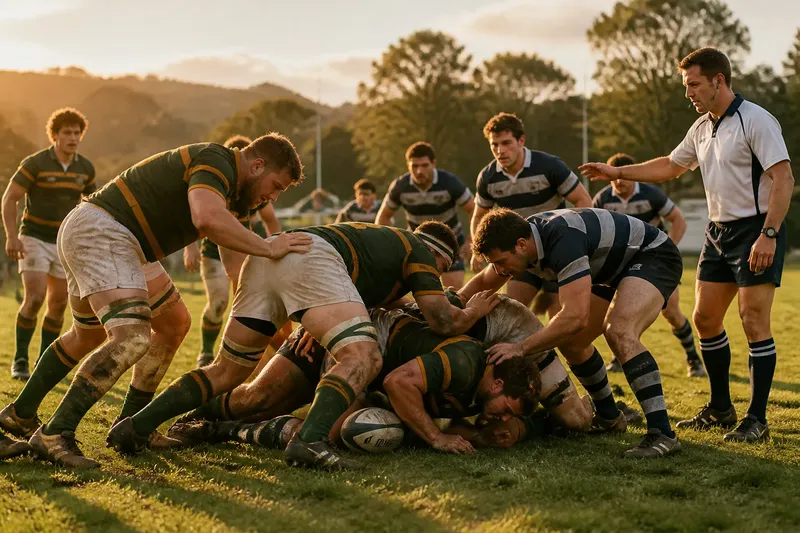
The front row consists of the loosehead prop, hooker, and tighthead prop. The props bind beside the hooker in the scrum. Their body position, binding, and ability to stay connected help the front row perform its role; they also carry, pass, and defend when play calls for it.
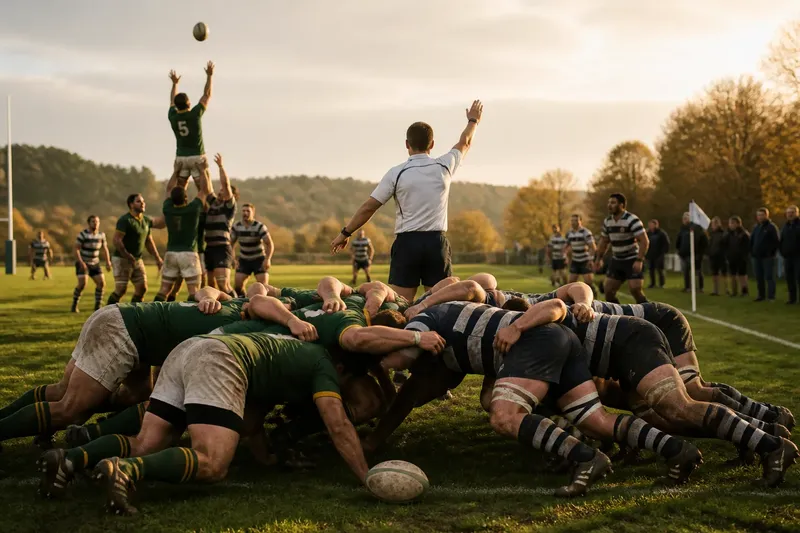
Locks join the scrum behind the front row and are often involved in lineouts, where teams compete for a throw. A lock’s responsibilities include timing a jump or supporting a teammate who is lifted, depending on the team’s method. The role is more than height: locks also take part in the team’s other forward work.
The back row consists of two flankers and the number eight. Flankers contribute to forward play and defense, while the number eight binds at the back of the scrum and can control or carry the ball from there. These roles overlap, but a player’s position affects the angle and timing of their involvement.
At a set piece, notice who is forming the unit, who is contesting the ball, and who is positioned to receive it. Those assignments make the forwards’ work easier to distinguish.
Back responsibilities
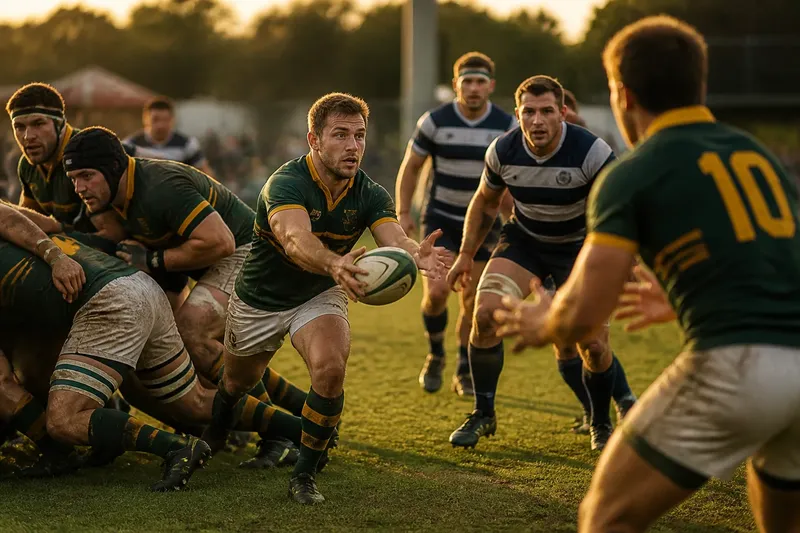
The scrum-half often moves the ball away from a scrum or another formation. The fly-half receives it and helps choose the next attacking option. Their partnership connects the forwards’ work to the wider team: one gets the ball moving, and the other helps determine where it goes next.
The inside and outside centers play between the halves and the wings. They may pass, carry into contact, or draw defenders to create an option for a teammate. Their position calls for quick decisions about whether to keep the ball moving, use a running line, or take contact.
Wings usually start in the outer channels, where they can receive the ball near the touchline and finish an attack. They also defend against opponents moving the ball wide. The fullback generally covers the deeper area behind the defensive line and can join an attack as a runner or kicker.
Imagine a team attacking toward its right touchline while the defense has shifted across. The fly-half sends the ball through the centers, and the fullback joins the attack as an extra runner. The visible result to watch for is whether that added option makes a defender commit to the fullback rather than staying focused on the wing.
Position questions?
Why does a player move away from a usual position?
A position describes a player’s primary responsibilities, not a fixed patch of field. Players move to carry out a task, support a teammate, or respond to the opposition.
Do teams use positions in the same way?
The position names and broad duties are familiar across teams, but coaches may emphasize different skills or decisions. Watch a player’s repeated responsibilities rather than drawing conclusions from one passage.
Why do shirt numbers match positions?
Traditional numbering gives spectators a quick guide to the lineup, with forwards generally wearing lower numbers than backs. Treat the number as a starting clue, then use the player’s actions to identify their role.
Can a player cover more than one position?
Some players are prepared to fill multiple roles, which can help a team adjust its lineup. Each position still has its own demands, so a player’s suitability depends on the team’s needs and the skills required.
Role-reading checklist
Check the front row at a scrum: if the props and hooker are bound in position, follow their connection through the contest; if someone is not part of that unit, watch for a different assignment rather than assuming they have a front-row role.
Check who throws at a lineout: if the hooker takes the throw, note that team’s arrangement; if another player throws, identify that player instead of treating the hooker’s throw as universal.
Check who contests a lineout ball: if a lock jumps or supports a jumper, note that role in the set piece; if another forward takes the contest, follow the team’s actual arrangement.
Check who moves the ball from a scrum: if the scrum-half collects and passes it, track the next decision through the fly-half; if another player handles the ball, follow the sequence without assigning the usual task automatically.
Check where the wings are positioned: if they are in the outer channels, look for their part in receiving or defending wide passes; if they move inside, follow the responsibility they have taken on there.
Check who is covering behind the defensive line: if the fullback is deep, note that backfield assignment; if another player is covering, identify that player rather than assuming the fullback is the only option.
Follow one role
Say you are watching an invented match situation in which a team’s wing receives the ball near the touchline with defenders already in front. First, note the starting picture: the wing has the ball, the defense is set, and the centers are standing close to the fly-half. Next, follow the pass backward in the sequence: the fly-half passed to the centers, who moved the ball on without drawing a defender. Then compare the available options: a center could run toward a defender before passing, or the fly-half could use a different route to involve another runner. The answer is not automatically that the wing has failed; the observable tradeoff is whether the changed approach draws a defender and gives the wing more room, or leaves the defense in place.
Use the same method for a player whose role seems unclear. Identify the starting situation, follow the actions that led to it, and compare the player’s responsibility with the team’s arrangement. This keeps one missed pass or tackle from becoming a verdict on the player’s position.
Roles in combination
Specialist positions connect through distinct assignments. At a lineout, one player throws, teammates contest the ball, and others prepare for the next play. After possession is secured, the scrum-half may move it on and the fly-half may choose the next option. Centers and wings then have their own responsibilities in the attack. The connection is useful to watch because it shows how one role sets up another without making the players interchangeable.
Pick a position and notice which recurring task belongs to it: a prop’s place in the scrum, a scrum-half’s pass from a formation, or a fullback’s backfield coverage. Then check whether the team has assigned that task to someone else. That distinction explains why rugby has so many specialist positions while leaving room for teams to arrange responsibilities in their own way.